Best Tools for Increasing Brand Visibility in AI Generated Answers in 2026
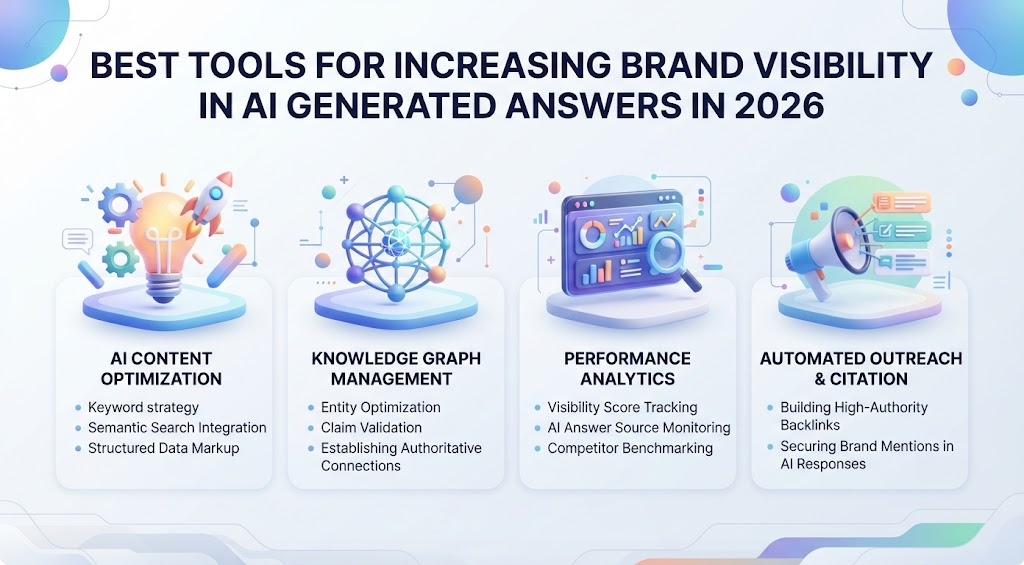
A brand can have strong organic rankings, a recognizable name, and plenty of website traffic and still be missing from the answers people receive from AI search.
That is because AI generated answers introduce a different visibility problem. A customer can ask which accounting platform is best for a small business, which project management tool is worth using, or which cybersecurity companies are leading the market without ever seeing a traditional search results page.
The brands that appear in those answers gain an opportunity to be considered. The brands that consistently disappear from them have a different problem to solve.
That makes AI visibility software useful for more than reporting. The better tools can show which questions matter, where competitors appear, which sources influence the answer, how a brand is described, and where there are practical opportunities to improve its presence.
There is also an important distinction to make before comparing these products. A visibility tool cannot force an AI system to recommend a brand. What it can do is expose the prompts, sources, content gaps, competitor patterns, and technical issues that a marketing team can work on.
With that in mind, these are the tools worth considering in 2026.
What Actually Helps a Brand Become More Visible in AI Answers?
The useful question is not simply whether a platform tracks ChatGPT or Gemini.
A stronger evaluation looks at what happens after the tool shows you a visibility problem.
For example, suppose a software company discovers that it appears in only 8 percent of the relevant AI responses it is monitoring, while its largest competitor appears in 31 percent. A basic tracker gives the company a useful warning.
A stronger system can answer the next questions:
- Which prompts are producing the gap?
- Which competitors appear instead?
- Which websites are being cited in those answers?
- Is the missing visibility connected to the company’s own content?
- Are third party publications influencing the results?
- Is the brand being mentioned but described incorrectly?
- Has visibility changed after new content or external coverage was published?
That difference is important throughout this market.
Some tools are primarily measurement platforms. Others connect measurement to content recommendations, technical optimization, source research, or external visibility work.
Our Tool Recommendations At A Glance
| Tool | Particularly useful for | Main strength |
| Ahrefs Brand Radar | SEO and research teams | Large search backed prompt database and source analysis |
| Verbatim Digital | Brands that need measurement plus execution | AI visibility tracking combined with GEO, entity, content, citation, and authority work |
| Semrush AI Visibility Toolkit | Established SEO teams | AI visibility, competitor research, prompt research, and technical auditing |
| Profound | Larger organizations | Detailed answer analysis, citations, sentiment, and real user prompt data |
| Peec AI | Marketing teams and agencies | Visibility analysis combined with source opportunities and prioritized actions |
| OtterlyAI | Focused AI search monitoring | Prompt research, citation tracking, content audits, and GEO recommendations |
| AirOps | Content intensive organizations | Connecting AI visibility data with content and third party visibility work |
| SE Ranking | SEO teams wanting AI tracking inside an existing platform | AI Results Tracker combined with traditional SEO capabilities |
1. Ahrefs Brand Radar
Ahrefs Brand Radar is particularly interesting for teams that already use search data to guide their marketing decisions.
The product tracks brand visibility across AI answers and gives users access to a large database of search backed prompts, drawn from real search behavior rather than synthetic queries. Ahrefs describes Brand Radar as covering a database in the hundreds of millions of monthly prompts, with coverage spanning Google AI Overviews, Google AI Mode, ChatGPT, Copilot, Gemini, and Perplexity. The exact figure moves often as Ahrefs expands its indexes, so it is worth checking Ahrefs’ current page rather than repeating a fixed number from any single point in time.
Brand Radar lets users benchmark AI share of voice, examine cited pages and domains, and find opportunities for brand mentions.
What makes the data useful
The source analysis is one of the more important features for a brand trying to improve visibility.
Ahrefs distinguishes between pages that AI systems actually cite and pages that were found during retrieval but were not cited in the final answer. That gives marketers a more useful picture than a simple count of mentions.
It can reveal, for example, that several competitors are repeatedly appearing in industry publications while your own site is rarely cited. That changes the question from “Why does AI not like my brand?” to a much more actionable investigation of which sources and topics are missing.
Best suited to
Ahrefs makes the most sense for teams that want:
- Large scale prompt research
- AI share of voice measurement
- Citation source analysis
- Competitor research
- AI visibility connected to broader SEO data
- Research across brands, products, regions, and other entities
Its limitation is that it remains primarily a data and research platform. Brands that want managed implementation or extensive external authority work will need additional resources.
2. Verbatim Digital
Verbatim Digital approaches AI visibility as an ongoing measurement and improvement process.
Its AI Visibility SaaS tracks how a brand appears across ChatGPT, Perplexity, and Google Gemini using structured prompts. The platform shows where the brand is mentioned and recommended, how it compares with competitors, and which sources AI systems rely on when producing answers.
That data becomes the starting point for its broader GEO work.
For brands looking at how to increase visibility in AI answers, this kind of tracking is useful because it reveals not only whether a brand is being mentioned, but also which competitors and sources are influencing those answers.
Verbatim’s public platform positioning connects visibility tracking with content optimization, citation building, authority strategies, technical GEO, and entity focused work. This gives it a different role from a tool that simply reports a visibility score.
Why It Is Worth Considering
The biggest advantage is the connection between diagnosis and implementation.
A brand can identify a prompt where a competitor is consistently recommended, investigate the sources behind those answers, and then address the underlying gaps through content, citations, authority building, or technical improvements.
Verbatim also publishes company reported case studies showing increases in AI share of voice. Its current site reports a 1,282 percent increase for Software Finder, a 30 percent increase for Anomali, and a 31 percent increase for Paylocity. These are reported results from Verbatim’s own case studies and should not be treated as independently audited industry benchmarks. It is worth confirming these figures are still live on Verbatim’s site before citing them elsewhere.
Best suited to
Verbatim is particularly relevant for brands that:
- Need to know where they are losing AI visibility
- Want competitor and prompt tracking
- Need help acting on visibility gaps
- Want external citation and authority work alongside content optimization
- Need a combination of software and human execution
- Are concerned with how AI systems describe and recommend their brand
Its main tradeoff is equally clear. Companies looking only for a lightweight self serve dashboard may prefer a software first product. Verbatim’s positioning is broader because it combines the platform with services designed to address the problems the data uncovers.
3. Semrush AI Visibility Toolkit
Semrush takes a broader approach by placing AI visibility inside its existing SEO and marketing ecosystem.
The AI Visibility Toolkit measures brand mentions and citations, tracks AI visibility against competitors, analyzes brand perception and sentiment, researches prompts, and provides a site audit for technical issues that may affect AI crawler access.
Semrush’s own knowledge base says its AI prompt database contains more than 289 million prompts and responses across ChatGPT, Gemini, Google AI Overviews, and Google AI Mode, with data updated daily.
Where Semrush becomes especially useful
The competitor research component can identify prompts where another company is being cited while your brand is absent. Semrush then connects those gaps with topics and content opportunities.
There is also a technical side. Its AI Search Site Audit is designed to identify issues that could prevent AI crawlers from accessing website content. That matters because visibility is difficult to improve when important information cannot be properly accessed or interpreted.
Semrush also offers AI Search Optimizer, which provides recommendations for improving content for both Google and LLM visibility.
Best suited to
It also complements AI powered SEO tools by combining AI-driven insights with established SEO workflows.
It is less compelling if the only requirement is basic AI mention monitoring. Its advantage comes from the combination of AI search data, traditional SEO data, content tools, competitor research, and technical auditing.
4. Profound
Profound is built around detailed analysis of AI generated answers.
Its Answer Engine Insights product measures visibility, share of voice, citations, sentiment, positioning, and the sources behind AI answers. Profound says it captures responses directly from consumer facing AI platforms rather than relying solely on API outputs.
The platform currently supports major environments including ChatGPT, Perplexity, Claude, Gemini, Google AI Overviews, Google AI Mode, Microsoft Copilot, Grok, and DeepSeek.
A useful feature for larger brands
Profound’s Prompt Volumes product is built on more than 1.3 billion real user AI conversations. Separately, the company’s newer Profound Index draws on more than 1.5 billion real user prompts across 50 or more industries and the top LLMs, giving marketers an industry wide benchmark rather than just their own tracked prompts.
That matters because a brand does not want to optimize around random prompts that nobody asks. It wants to understand the questions people actually use when researching its category.
Profound also analyzes how AI describes a company, including sentiment and recurring themes. Its system can identify inaccurate claims and the sources associated with those claims.
Best suited to
Profound is particularly appropriate for:
- Large brands
- Enterprise marketing teams
- Companies tracking multiple markets or product lines
- Teams that need detailed citation analysis
- Organizations concerned with brand perception inside AI answers
- Companies that want real user prompt data
The tradeoff is scale. A small business looking for a straightforward visibility checker may not need the depth of an enterprise focused platform.
5. Peec AI
Peec AI puts considerable emphasis on turning visibility data into specific decisions.
Its platform measures visibility, average position, sentiment, and share of voice while showing the prompts and sources associated with those results. It can also identify the third party sites that AI systems cite most frequently within a category.
The more interesting part is its Actions feature.
Actions analyzes sources across tracked AI responses, groups them into Owned Media opportunities (content on a brand’s own site) and Earned Media gaps (editorial coverage, Reddit and forums, reference sites), compares competitor presence, and assigns each a relative opportunity score. The resulting recommendations can point teams toward content to create, pages to improve, or external sources where a brand may need to build a presence.
Why that matters
Consider a brand that appears regularly for branded questions but disappears when customers use generic category searches.
A visibility graph tells the company that the problem exists.
Peec can go further by showing the sources and content types associated with competitor visibility. Its Earned Media functionality also looks at external sources such as editorial content, Reddit discussions, review sites, and other material that can influence AI answers.
That makes it particularly useful when the visibility problem extends beyond the company’s own website.
Best suited to
Peec AI is a good match for:
- Marketing teams
- Agencies
- Brands that need competitor comparisons
- Teams researching which sources influence AI answers
- Companies that want prioritized recommendations rather than raw reporting
Peec is still a software platform. The recommendations identify what to work on, but the brand remains responsible for carrying out the resulting content or external visibility work unless it uses another provider.
6. OtterlyAI
OtterlyAI focuses specifically on AI search monitoring and optimization.
The platform tracks brand mentions, website citations, competitors, prompts, and visibility across ChatGPT, Google AI Overviews, Google AI Mode, Gemini, Perplexity, Microsoft Copilot, and Claude. It also provides content auditing, crawlability checks, and GEO recommendations.
One technical detail is worth noting. OtterlyAI’s own methodology says it collects its monitoring data by interacting directly with public AI interfaces rather than relying on APIs, since API responses can differ from what a real user sees on ChatGPT.com or Perplexity.ai. The company argues that this allows its captured responses to more closely reflect what users actually see.
Why marketers may prefer it
OtterlyAI keeps the workflow relatively focused.
You can research prompts, monitor what happens to your brand, inspect citations, compare competitors, audit content, and receive optimization recommendations without adopting a much larger general purpose marketing suite.
The platform also supports brand reporting and domain citation tracking, including changes in link positions over time.
Best suited to
It is particularly useful for:
- Marketing teams focused specifically on AI search
- Agencies managing multiple brands
- Businesses that want prompt monitoring
- Teams interested in citation tracking
- Companies that need content and crawlability recommendations
Its narrower scope can be an advantage for teams that do not need the wider SEO environment offered by Semrush or Ahrefs.
7. AirOps
AirOps takes a different route because its platform connects AI visibility data with content production and third party visibility work.
Its Insights product tracks AI search visibility across ChatGPT, Perplexity, Claude, Gemini, Google AI Overviews, and Google AI Mode. It can show the topics, prompts, domains, and content types associated with visibility.
The company’s Offsite product is especially relevant to brands that have already optimized their own websites but remain absent from the sources AI systems rely on.
AirOps says Offsite identifies third party publishers that influence AI answers, prioritizes them using its Influence Score, supports outreach, and measures visibility changes after placements.
An interesting finding from AirOps research
AirOps reports that up to 85 percent of brand discovery in AI search comes from third party content such as listicles, comparison guides, community discussions, and niche publisher articles, rather than a brand’s own product pages or blog. That figure comes from AirOps’ own launch research for its Offsite product and should be treated as a vendor specific finding rather than a universal measurement for every industry.
The distinction is important.
The number should not be read as proof that every brand needs a particular percentage of external coverage. It illustrates why AirOps places such a strong emphasis on content outside a company’s own domain.
Best suited to
AirOps is particularly relevant for organizations with:
- Large content teams
- Significant publishing programs
- Existing SEO operations
- A need for third party visibility work
- Multiple pages or topics to optimize
- Teams that want visibility data connected directly to content execution
Its workflow orientation makes it less suitable for a company that only wants a simple AI visibility report.
8. SE Ranking AI Results Tracker
SE Ranking brings AI visibility tracking into a traditional SEO platform.
Its AI Results Tracker supports ChatGPT, Perplexity, Gemini, Google AI Overviews, and Google AI Mode. Users can configure brands, prompts, competitors, and AI platforms and then monitor rankings and visibility over time.
The Rankings section reports metrics such as Top 3 Presence, Source Presence, and mention and link presence. It can also show which brands and source URLs appear for tracked prompts.
Why this can be useful
SE Ranking is especially practical for an SEO team that does not want to maintain a separate system for AI visibility.
The same project can contain traditional search data alongside AI search tracking, making it easier to compare conventional rankings with AI presence.
For example, a page could rank well organically but have little presence in AI answers. That does not automatically mean the page is ineffective, but it gives the team a reason to investigate what sources and content types are being used in the AI results instead.
Best suited to
SE Ranking is a sensible option for:
- SEO teams
- Agencies
- Companies already using SE Ranking
- Businesses monitoring several competitors
- Teams that want AI and traditional search data together
Its main limitation is that it is more measurement oriented than a managed AI visibility service. Teams still need to decide what changes to make after identifying a visibility gap.
Which Tool Makes Sense for Different Visibility Problems?
There is no single platform that is automatically best for every brand.
The better choice depends on what you are trying to change.
If your team is heavily invested in SEO research, Ahrefs Brand Radar gives you a large search backed prompt dataset and detailed source information.
If you need visibility data plus hands on execution, Verbatim Digital is worth a close look because its platform is connected to GEO, content, citation, entity, and authority services.
If you want AI visibility within a broader marketing platform, Semrush provides prompt research, competitor analysis, AI visibility measurement, and technical auditing.
If you manage a large brand and need detailed answer analysis, Profound offers visibility, citations, sentiment, positioning, and extensive prompt data.
If the next action matters as much as the measurement, Peec AI’s Actions feature is designed to turn competitor and source data into prioritized opportunities.
If you want a focused AI search monitoring product, OtterlyAI combines prompt research, brand monitoring, citation tracking, and content audits.
If your organization has a substantial content operation, AirOps connects visibility measurement with content production and third party visibility work.
If you already use an SEO platform and want AI tracking alongside it, SE Ranking provides AI Results Tracker within its existing environment.
One Important Point About Measuring Progress
AI visibility numbers should never be treated like permanent Google rankings.
AI systems can produce different answers to the same question. Sources change. Models change. Search indexes change. New competitors enter a category. A brand can therefore move up or down without making a corresponding change to its website.
That is why useful measurement should look at trends rather than one isolated answer.
A practical monitoring program should track:
- The prompts that matter commercially
- Brand mention frequency
- Position within AI answers
- Share of voice against competitors
- Citation frequency
- The domains and pages being cited
- How the brand is described
- Changes by AI platform
- Changes by market or region
- Visibility before and after major content or authority work
Ahrefs, Verbatim Digital, Semrush, Profound, Peec AI, OtterlyAI, AirOps, and SE Ranking all provide different combinations of these measurements.
Frequently Asked Questions
What is an AI visibility tool?
An AI visibility tool monitors how often and where a brand appears in AI generated answers. Depending on the platform, it may also track prompts, competitors, citations, source domains, sentiment, positioning, and changes over time.
Can AI visibility tools guarantee that a brand will be recommended?
No. These tools can measure and analyze AI generated responses, but they cannot guarantee that an AI system will mention or recommend a particular brand. Visibility can change based on the model, prompt, sources available to the system, location, and other factors.
What should I track when measuring AI visibility?
The most useful metrics include brand mentions, position within answers, share of voice, citations, linked mentions, competitor visibility, and the websites being cited. It is also useful to monitor how AI systems describe the brand, especially when accuracy or positioning is important.
Is AI visibility the same as traditional SEO?
No. There is overlap, but AI visibility involves additional factors. A page can rank well in traditional search and still have limited visibility in AI generated answers. AI visibility tools help identify these differences and show which sources and information are influencing AI responses.
How often should a brand monitor its AI visibility?
Regular monitoring is more useful than occasional checks because AI responses and source patterns can change. For brands actively working on their visibility, tracking important prompts over time makes it easier to identify meaningful changes and evaluate whether optimization efforts are having an effect.
Which AI visibility tool is best for a brand?
It depends on what the brand needs. Ahrefs and Semrush are useful for teams that want AI visibility within broader SEO platforms. Verbatim Digital is suited to companies looking for visibility tracking alongside GEO, content, citation, entity, and authority work. An SEO strategist can help brands evaluate these tools and choose the approach that best aligns with their visibility goals.
Can a brand improve its visibility after identifying a problem?
Yes, but the solution depends on what the data reveals. A visibility gap may point to missing or unclear information on a company’s website, weak third party coverage, limited citations, technical accessibility problems, or stronger competitor representation. The purpose of monitoring is to identify those gaps so they can be addressed.